
What Is TB-500? Understanding Thymosin Beta-4, Research, Safety & Risks
Introduction
What is TB-500, and why is it discussed alongside thymosin beta-4? The names are frequently combined in commercial peptide listings, but they do not always describe the same substance. This difference matters when reading scientific studies, comparing product specifications, or assessing safety claims. Full-length thymosin beta-4 (Tβ4) is a naturally occurring 43-amino-acid peptide. The FDA, by contrast, identifies TB-500 as an N-acetylated seven-amino-acid fragment corresponding to residues 17–23 of thymosin beta-4. Research on one should not be automatically attributed to the other.
What Is TB-500?
Understanding TB-500 and thymosin beta-4
Thymosin beta-4 is present in many tissues and participates in actin-related cellular processes. Actin is a structural protein involved in cell shape and movement. The shorter TB-500 fragment includes the LKKTETQ region of thymosin beta-4. Although these molecules share a sequence region, they differ substantially in size and composition. The FDA’s substance database explicitly defines TB-500 as a seven-residue peptide, rather than the full-length molecule.[Source]
Why identity and sequence matter
The commercial label alone is insufficient to identify a research material. Researchers should consult its amino-acid sequence, chemical form, batch number, and analytical results. Differences in peptide length, modifications, or impurities may affect how materials behave in experiments. A certificate of analysis (COA) is useful for documenting what a particular laboratory tested; it is not evidence of clinical safety.
Pulse Research batch example
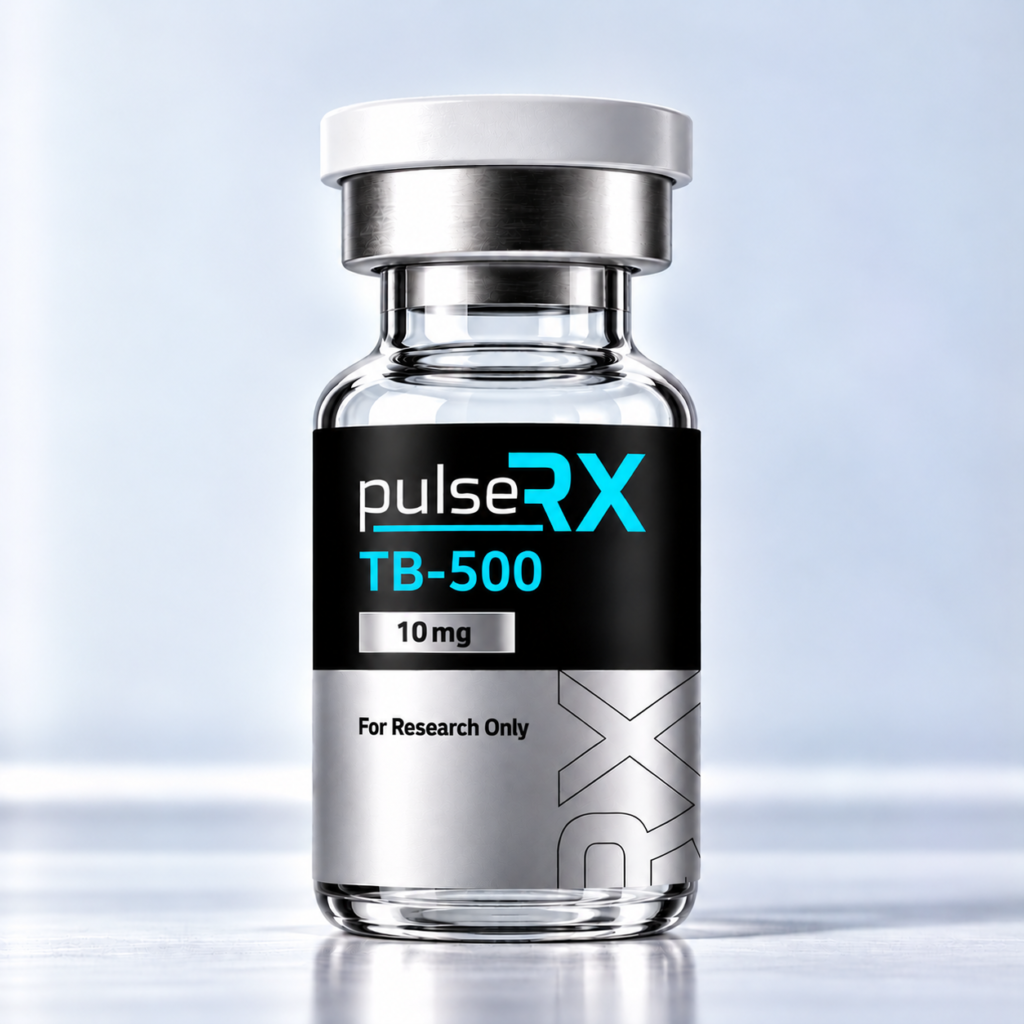
For batch PRX-TB10-0726-B1, a Freedom Diagnostics COA dated July 11, 2026 reports identity as thymosin beta-4 by LC-MS, 99.25% purity by HPLC-UV, and measured net content of 13.16 mg for a product labeled 10 mg. In subsequent correspondence, the laboratory identified the sample as full-length thymosin beta-4, CAS 77591-33-4. These results refer to the tested batch only and do not establish sterility, clinical effectiveness, or suitability for human use.
How Does Thymosin Beta-4 Work?
Actin and cell migration
A major focus of thymosin beta-4 research is its interaction with monomeric actin. Cells continually reorganize actin as they move, divide, and respond to their surroundings. Laboratory work has explored how thymosin beta-4 and portions of its sequence influence these processes. A mechanism observed in cultured cells, however, is not equivalent to a demonstrated medical benefit.
Proposed biological effects
Researchers have investigated thymosin beta-4 in connection with cell migration, angiogenesis (formation of blood vessels), and inflammatory signaling. These processes are relevant to tissue biology but are also complex and context-dependent. A molecule that changes one biological marker does not necessarily improve outcomes in a living person. Research on the seven-residue TB-500 fragment requires separate interpretation from research on full-length thymosin beta-4.[Source]
Laboratory, animal, and human evidence
Cell experiments can help reveal mechanisms; animal experiments can test responses in complex organisms; controlled human trials are needed to evaluate specific clinical outcomes and adverse effects. Each step answers a different question. Positive findings in a cell or animal model should not be presented as proof of safe or effective human use.
What Does Scientific Research Say?
Preclinical evidence
Published investigations of thymosin beta-4 have examined actin regulation and experimental wound-related biology. Some studies have examined short fragments and specific sequence regions. To interpret a study accurately, readers should check the exact peptide, route of administration, experimental model, and measured endpoint. The FDA’s 2026 briefing distinguishes studies of full-length thymosin beta-4, non-acetylated fragments, and TB-500 itself.[Source]
Human studies of full-length thymosin beta-4
A published double-blind, placebo-controlled Phase 2 study randomized 73 people with venous stasis ulcers to investigate topical thymosin beta-4. The investigators reported acceptable tolerability in that study and preliminary signals warranting further investigation. The trial was limited to a specific topical formulation and clinical population. It does not establish efficacy or safety for injected preparations, general recovery claims, or the shorter TB-500 fragment.[Source]
Human evidence for the shorter TB-500 fragment
The FDA’s 2026 review reported that it had not identified human exposure data for the thymosin beta-4 fragment it calls TB-500. Accordingly, human results obtained with full-length thymosin beta-4 should not be transferred to TB-500 without direct supporting research. A shared sequence is not a substitute for a clinical trial.[Source]
TB-500 Benefits: Claims Versus Evidence
Tissue repair claims
Interest in tissue repair comes largely from experimental studies of thymosin beta-4 and related sequences. Such studies may identify promising mechanisms, but the findings do not demonstrate that a commercial product accelerates healing in humans. It is essential to specify whether a study used full-length thymosin beta-4 or a shorter fragment.
Recovery and inflammation claims
Claims about faster recovery, injury treatment, and reduced inflammation circulate widely online. They should not be confused with established clinical outcomes. The published topical thymosin beta-4 study addresses a particular wound condition, not athletic performance or general recovery. The absence of reliable direct human evidence is especially important for the shorter fragment.
What can be concluded?
The scientific literature provides reasons to investigate these molecules further. It does not support broad promises of healing, improved athletic performance, or treatment of disease. Readers should give greater weight to controlled studies and official assessments than testimonials or marketing claims.
Side Effects, Safety, and Potential Risks
What is known and unknown
A reliable human adverse-effect profile cannot be assumed for either all full-length thymosin beta-4 formulations or the TB-500 fragment. Even where a particular topical preparation was tolerated in a limited clinical trial, the findings cannot be generalized to other formulations, doses, populations, or routes. Long-term exposure and uncommon adverse events require appropriately designed studies.
FDA concerns about the fragment
The FDA identifies possible immunogenicity concerns, aggregation, and peptide-related impurities for compounded products containing the thymosin beta-4 fragment known as TB-500. The agency also reports insufficient human exposure data. Those specific findings concern the fragment and should not be described as direct clinical results for full-length thymosin beta-4.[Source]
Testing and quality control
Identity testing, purity testing, and mass determination answer different analytical questions. For example, LC-MS may support identity assignment and HPLC-UV may estimate purity under defined methods. Neither result, by itself, demonstrates sterility, absence of endotoxins, or human safety. Product quality discussions should identify which tests were actually performed on the cited batch, rather than imply that one purity percentage guarantees overall safety.
Is TB-500 Approved for Human Use?
As of October 2026, TB-500 is not an FDA-approved medicine for human use in the United States. Full-length thymosin beta-4 is likewise not an FDA-approved human medicine. The FDA discussed the shorter TB-500-related substances at a July 2026 Pharmacy Compounding Advisory Committee meeting; consideration for compounding is not equivalent to FDA approval. An FDA warning letter issued in January 2026 also discussed unapproved thymosin beta-4 biological products. Regulatory status should be rechecked before publication and when the article is updated.[Source]
A “research use only” label describes intended use; it does not confer drug approval or establish safety for administration to people. Research material specifications should be kept separate from clinical claims.[Source]
TB-500 vs. BPC-157
TB-500 and BPC-157 are chemically distinct peptides. The former is identified by the FDA as a fragment of thymosin beta-4; BPC-157 is a separate 15-amino-acid synthetic peptide. Their experimental research histories differ, and results for one cannot establish outcomes for the other. Neither should be presented as a proven treatment based on preclinical findings alone. Direct, well-controlled human evidence is needed to establish any particular medical use.[Source]
Frequently Asked Questions
What is TB-500?
In the FDA’s terminology, TB-500 is a synthetic, acetylated seven-amino-acid fragment of thymosin beta-4. Some commercial sellers use the name more broadly, so a product label alone does not confirm molecular identity.
Is TB-500 the same as thymosin beta-4?
No. Full-length thymosin beta-4 contains 43 amino acids. The FDA-defined TB-500 fragment contains seven. Because the molecules are different, evidence about one cannot simply be assigned to the other.
Does full-length thymosin beta-4 have human research?
Yes. Published research includes a small randomized Phase 2 study of topical thymosin beta-4 in venous ulcers. The findings are formulation- and condition-specific and do not prove benefits for other uses.
Is TB-500 FDA approved?
No. As of October 2026, TB-500 is not an FDA-approved medicine for human use in the United States. The research-use-only designation is not a form of drug approval.
What are the main safety concerns?
Human safety information is insufficient for broad conclusions. For the TB-500 fragment, the FDA has highlighted possible immunogenicity, aggregation, and impurity concerns. Testing for purity does not establish human safety.
Is TB-500 permitted in competitive sports?
The World Anti-Doping Agency prohibits thymosin beta-4 and its derivatives, including TB-500. Athletes should consult the current Prohibited List and applicable sporting authority before making decisions.
Is TB-500 the same as BPC-157?
No. They have different amino-acid sequences and research backgrounds. They should not be grouped together as though they share proven effects or equivalent human safety evidence.
Why does the CAS number matter?
A CAS number helps identify a chemical substance. Pulse Research’s laboratory correspondence identifies its tested full-length thymosin beta-4 sample with CAS 77591-33-4. Identity should also be checked against sequence and analytical documentation.
Conclusion
The question “What is TB-500?” has an important scientific answer: terminology matters. Full-length thymosin beta-4 and the shorter fragment called TB-500 by the FDA are different molecules. Published studies of thymosin beta-4, including limited human research on a topical preparation, are valuable but cannot be generalized to every product or use. The shorter TB-500 fragment has its own substantial evidence gaps. For responsible interpretation, readers should examine the exact sequence, batch documentation, study design, and current regulatory status. Scientific interest is not the same as proven clinical benefit. Reliable conclusions require appropriately designed research, careful quality assessment, and transparent reporting of limitations.
References and editorial links
- FDA: TB-500 substance identity
- FDA: thymosin beta-4 identity
- FDA: TB-500 safety assessment
- FDA: 2026 TB-500 review
- FDA: July 2026 advisory meeting
- PubMed: Phase 2 topical thymosin beta-4 study
- FDA: January 2026 thymosin beta-4 warning letter
- WADA: anti-doping TB-500 research
Recent Post